- Blow On The Cartridge
- Posts
- Yoda Stories
Yoda Stories
LucasArts tried something odd with this one.
In partnership with

RETRO NEWS
It’s a slower week in the world of retro gaming, but there are still a few fun stories worth checking out.
Tetris is getting some unexpected love on the Sega Master System nearly four decades later, while Japan’s long-running Game Center CX has officially decided the PS3 and Wii are old enough to join the retro club.
And for anyone still playing classic consoles on modern displays, the new RetroTINK 6X CE promises powerful 1440p scaling without the premium price tag. Not the busiest week for retro news, but enough to keep our old consoles feeling young.
Tetris Finally Lands on Sega Master System Nearly 40 Years Later
A new homebrew port faithfully brings Sega’s 1988 arcade Tetris to Master System. Read more here...
Game Center CX Officially Welcomes PS3 and Wii Into the Retro Club
After viewer voting, the Japanese gaming show will finally feature PS3 and Wii titles. Read more here...
RetroTINK’s New $230 Scaler Brings 1440p Upgrades to Classic Consoles
The RetroTINK 6X CE offers 1440p output and advanced CRT effects at $230. Read more here...
PRESS START
An Introduction To Today’s Game

Not every Star Wars game needed a story. Yoda Stories skipped one entirely and let the missions write themselves.
Every time you booted it up, Luke Skywalker landed on Dagobah, got pointed toward a random planet, and set off on whatever job the game decided to hand him that day. Rescue somebody, blow up an Imperial base, dig up an artifact, repeat.
100% random. Every time you played.
It's a strange little entry in the Star Wars catalog. LucasArts built it as an infinitely replayable puzzle game meant for short sessions, not a saga.
On paper, this sounded like a great idea and a little ahead of its time. Execution though, it needed some work.
BEHIND THE PIXELS
Let’s Dive Into The Game
Picture handing a friend a Star Wars game with no ending and no fixed story, just a machine that keeps generating new short jobs for Luke to run.
That is basically what Yoda Stories is. It came out in 1997 for Windows and later got ported to Game Boy Color in 1999 by Torus Games.
It's the second entry in LucasArts' Desktop Adventures series, following Indiana Jones and His Desktop Adventures, and it turned out to be the last one too.

Structurally it's a top-down action adventure puzzle game, closer in spirit to an old Zelda dungeon crawler than a traditional Star Wars story.
Each new game drops you on Dagobah as Luke, sends you to find Yoda, and hands you a randomly generated mission on a desert, snow, or forest world.
From there you're solving light puzzles, fighting basic enemies, and hunting down whatever objective got assigned, whether that's freeing a captured ally, planting explosives at an Imperial facility, or tracking down a lost item.

The mechanics are simple by design. Combat mostly comes down to walking into enemies with a lightsaber or firing a blaster, and the puzzles lean on basic item collection and key-and-lock logic rather than anything intricate.
The appeal was always about the randomization, since the same rough formula could reshuffle into a slightly different layout and objective each time you played. That's also the game's biggest limitation.
The pool of building blocks is small enough that the variety wears thin faster than the concept promises.

Visually it holds up about as well as you'd expect from a mid-90s PC adventure title, with flat, simplified sprite work and character designs that lean cutesy rather than cinematic. Animation is clunky though and can be jarring as you move Luke around.
The audio does its job without doing much else. None of it was chasing realism. It was built to be quick, replayable, and easy to pick up between other things, and on that narrow goal it mostly delivers.
Stop making AI decisions in the dark.

Leadership is asking: are we getting value from AI? Which tools are worth the spend? Where are we exposed? Right now, most teams have no idea.
Harmonic Security Usage Explorer changes that.
You get a complete picture of how your organization uses AI, automatically categorized into custom tasks and use cases.
You’ll see the projects being worked on, who’s using what tools, where AI investments are driving value, and where employees are engaging in risky behavior.
CIOs can rationalize spending and cut wasted licenses. CISOs can pinpoint where risk exists and neutralize it. AI committees can show exactly how their efforts are paying off.
GAME INFORMATION
System: Windows PC
Year Released:
1997 (NA)
Developer: LucasArts
Publisher: LucasArts
MobyGames:
Critics: 58 (17 Reviews)
WHERE TO PLAY
The original copy or emulation will be your best bet in playing the original version.
Original Copies of the Game (All prices in USD)
Loose: $7
Complete: $14
New/Sealed: $75
COVER ART

One idea shouldn't take six rewrites to post.

Posting everywhere means rewriting one idea six times, so you post to one, or none. SureThing turns one idea into native posts for every platform.
GAME OVER
Why You Should Play This
There's no official way to play Yoda Stories today. It never got a Steam release, a GOG rerelease, or a spot on any retro collection, though fans have been asking GOG for one for years.
The most reliable route on PC is DREAMM, a tool built specifically to run old LucasArts games on modern systems. The Game Boy Color version is out there through emulation too, if you'd rather carry Luke's random missions around in handheld form.
Worth playing today is a fair question. It's a slight game, and even in 1997 some reviewers weren't kind to it.
But there's a real charm in a Star Wars game that never asked you to follow a script, and plenty of people who grew up with it still talk about it fondly. It won't hold your attention for hours at a stretch, but it's a fun little curiosity worth understanding, even if you never boot it up yourself.
It would be awesome to see someone take this idea and build upon it today. One can hope.
Until next time, friends!

SUPPORT
This is a passion project made with love, and every open or read means the world.
If you’d like to show extra support, you can use the button below.
RETRO HARDWARE
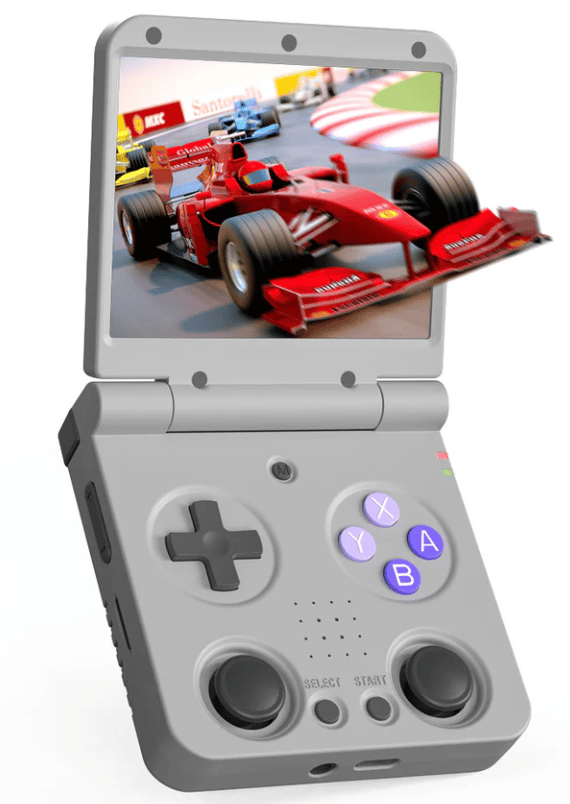
Miyoo Flip V2 Retro Handheld Game Console
The Miyoo Flip V2 is a tiny clamshell retro handheld that lets you carry a whole library of classic games in your pocket. With a bright screen, solid controls, and the nostalgic flip design we all remember, it’s perfect for quick gaming sessions anywhere. Click the picture to check it out. My readers can use the following code for a 12% discount: NY12
Reply